

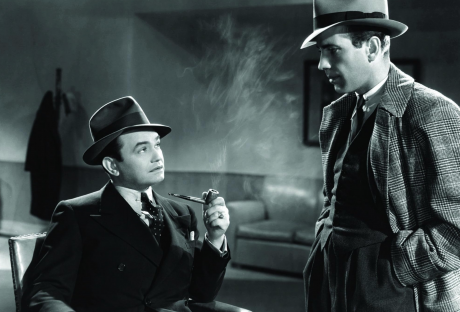
Warner Bros., 1936. Director: William Keighley. Screenplay: Seton Miller, based on a story by Martin Mooney and Miller. Camera: Hal Mohr. Film editor: Jack Killifer. Cast: Edward G. Robinson, Joan Blondell, Barton MacLane, Humphrey Bogart, Frank McHugh, Joseph King, Richard Purcell, George E. Stone.
Once again we find ourselves in a hugely consequential election month, and once again the Warner Bros. classics vault provides an appropriate film for the occasion: Bullets or Ballots. The title refers, of course, to the importance of preserving the rule of law over the forces of crime. Henry O’Neill, as a fictional anti-crime crusader in a public-service film within the film, puts it succinctly in the first scene. “They rule by the fear of their bullets,” he tells the audience. “They must be smashed by the power of your ballots.” It’s an imposing statement, but within moments O’Neill is mowed down by one of those bullets, and it’s clear that law and order needs a new and more powerful champion.
Enter Edward G. Robinson as a seasoned detective on the city police force, a veteran whose long service and tough-but-fair methods have earned him the respect of acquaintances on both sides of the law. His record of accomplishments should entitle him to a distinguished rank—but instead he’s demoted and finds himself walking a beat in the Bronx. Then, compounding the injustice, he’s dismissed from the force altogether for no apparent reason. Bitterly resentful, he accepts the offer of a gang leader to join his crime syndicate. Now Robinson’s wealth of experience, in bringing the criminal elements to justice, will be put to work in service of the criminal elements themselves. Or will it?
Edward G. Robinson had become a major Warners star in Little Caesar, and other gangster classics, in the pre-Code years of the early 1930s. Now, a scant five years later, times had changed radically. The establishment of the Production Code Administration in 1934 had imposed new restrictions on the studio, not least on the production of crime films. Earlier films in this genre, the PCA ruled, had the effect of glorifying the criminals; from this point on, care must be taken to enlist the audience’s sympathies on the side of law and order. Warners had responded in 1935 by casting James Cagney, formerly a top movie gangster, as an FBI agent in G-Men.
Now, in 1936, it was Robinson’s turn. His character in Bullets or Ballots, Johnny Blake, is a thinly veiled portrait of real-life New York cop Johnny Broderick. Already a fixture on the force for years, Broderick had become a legend in the world of law enforcement, largely for his rough treatment of wrongdoers. “Rough treatment” is an understatement; miscreants who crossed his path frequently ended up in the hospital. Even in an era far more tolerant of police brutality, Broderick’s methods were seen as extreme.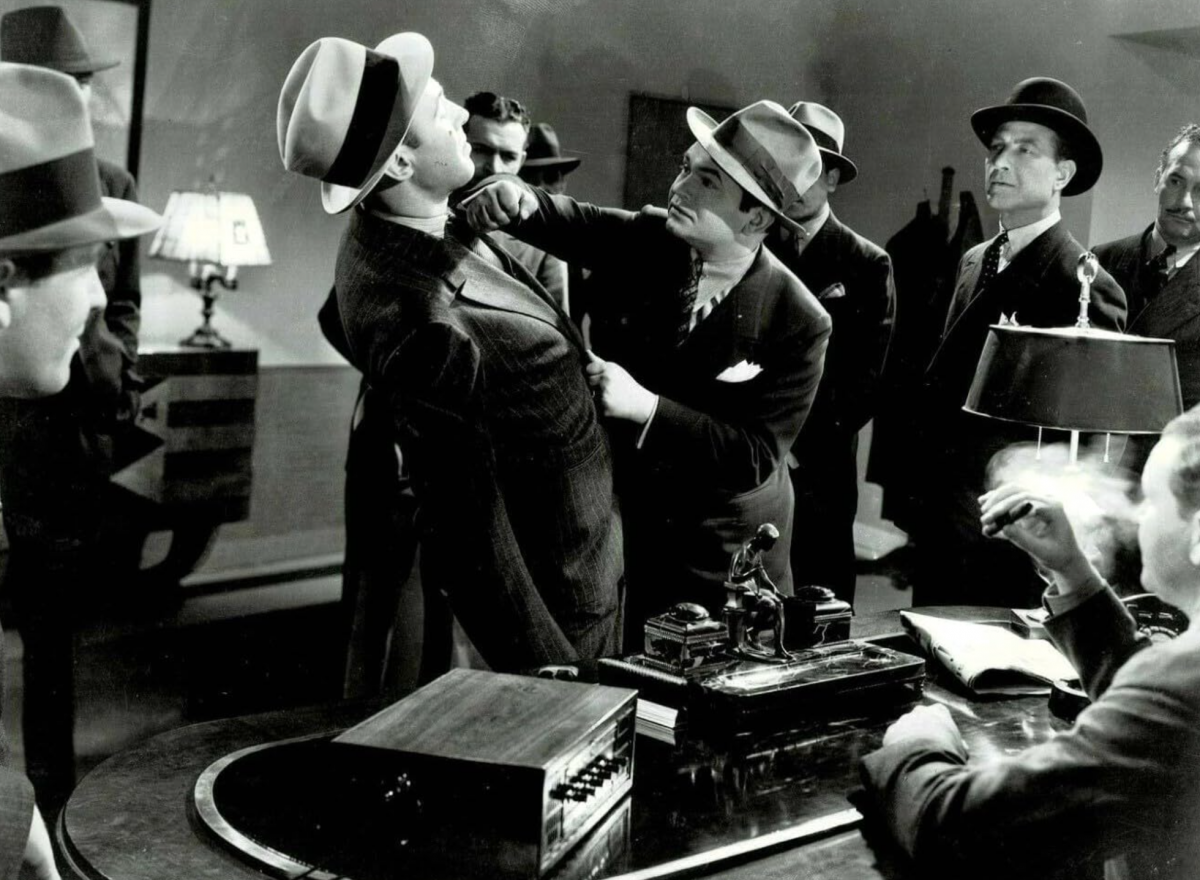 Warners, in concocting a fictional version of this terror, smoothed away the rough edges and made him far more sympathetic. Robinson’s character knocks some low-level hoods around in the course of the film, but compared to the real-life Broderick, he’s practically a saint.
In the tradition of stories “ripped from the headlines,” the studio signed the reporter who had actually written some of those headlines. Martin Mooney, a reporter for the New York American, had written a sensational series of articles in 1935 exposing the workings of the numbers racket in New York. When he refused to reveal his sources to a grand jury, he was sentenced to thirty days in jail. A hard-bitten journalist of the old school, Mooney was unfazed by this development. He bounced back handily by selling stories about the numbers racket to the movies—first to MGM, for Exclusive Story (1936), then to Warner Bros. for Bullets or Ballots. For the Warners film he collaborated with studio writer Seton Miller (who had written G-Men the previous year). Their story focused on the fictional Johnny Broderick character and relegated the numbers racket to a subplot, treating it as a minor and relatively harmless crime. This movie proved to be a career turning point for Mooney, who became a prolific screenwriter and associate producer in succeeding years. His many later credits included the film noir classic Detour (1946).
Full disclosure: I have a personal soft spot for Bullets or Ballots because of a privileged glimpse behind the scenes. Many years ago, when Leith Adams was the head of the Warner Bros. Archives, he gave Scott MacQueen and me a quick impromptu tour of the Warners backlot. Over the years, many of the standing sets on the backlot had succumbed to fires or the elements, but the “Brownstone Street,” originally built in the late 1920s, was still intact. Like most backlot streets, it consisted of a row of buildings constructed only as false fronts, to be filmed in exterior shots; interiors were shot inside the sound stages. But, as Leith demonstrated to us that day, one of those brownstone buildings was different: the front door opened into a working vestibule set, suitable for interior filming, complete with a stairway that led up to the next floor. This gave the filmmakers an added measure of flexibility in shooting city scenes—a flexibility that was used to good effect in filming the chase, retreat inside a building, and shootout on the stairs in the climactic scene of Bullets or Ballots.
Special thanks to Margaret Kaufman.
