

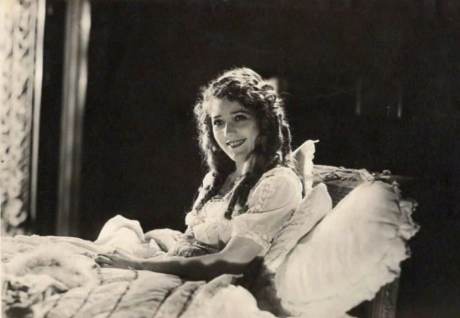
Pickford/Artcraft, 1918. Director: Marshall Neilan. Scenario: Frances Marion, based on the novel by William J. Locke. Camera: Walter Stradling. Cast: Mary Pickford, Conway Tearle, Marcia Manon, Ida Waterman, Herbert Standing, Josephine Crowell.
At any given time I tend to have multiple writing projects in the works, and most of them are long-term projects, sometimes taking years to complete. Accordingly, I try to keep this column separate, a monthly break to revisit the many classic films that are not part of my major commitments. This month I’m making an exception. It’s been my great privilege this year to contribute part of the program for Le Giornate del Cinema Muto, the world’s leading silent-film festival, held annually in Pordenone, Italy. I’ve worked on some of the Giornate programs in the past, but this is a step up: I’ve had the opportunity to curate an entire retrospective of the films of director Marshall Neilan. Some readers of this column may know that Neilan was a colorful figure in American film history, a director whose offscreen life was almost as lively and entertaining as his films.
And that’s saying something, because Neilan was an uncommonly talented director, a craftsman who could take the slightest of story material and (when he felt like working) bring it to the screen as compelling, entertaining cinema. His filmography covers a range of genres, and we’re screening a sampling of his pictures at the festival to illustrate the varied highlights of his career.
Even so—and even considering the criminally small percentage of his work that is known to survive at this date—there are still some outstanding films that we just couldn’t squeeze into the schedule. So I’m using this month’s column to showcase one of my favorite Neilan films that didn’t make the Pordenone program: Stella Maris, a true classic and a film that is all too often overlooked. By 1917, Neilan’s talents had brought him to the attention of Mary Pickford, one of the biggest movie stars of that or any other time. Pickford was a shrewd businesswoman as well as a gifted actress, and by 1917 she was the head of her own studio, with full control over her productions. She found Neilan to be a congenial (if sometimes “aggravating”) coworker and a topnotch director. During 1917–18 he directed five of her features in a row; all five were among her most notable films, and all have been archivally preserved to this day.
Midway through this distinguished run came Stella Maris, based on a novel by British author William J. Locke. Among other things, this film helps demonstrate Neilan’s and Pickford’s versatility, for some of their films together are primarily distinguished by whimsy and charm. Stella Maris is something different. Here the star plays a dual role—not an unusual device in 1918; dual roles had become something of a fashion for female stars in the mid-1910s. But here it’s more than a gimmick; this is no lighthearted tale of mistaken identity. We see Pickford first in the title role: Stella Maris, a lovely young girl paralyzed from childhood. She is doted on by a wealthy aunt and uncle who not only shelter her, but actively isolate her from any contact with the unpleasant, sordid side of life. In Stella Maris’ world, all is happiness and beauty, and ugly realities like crime, poverty, or cruelty simply do not exist.
Unity Blake, an “ugly duckling” in a London orphanage, inhabits a very different world, a cold world of privations and hostility. Mary Pickford reportedly insisted on playing this role as well, and took an active part in devising Unity’s bedraggled appearance, complete with twisted mouth, slumped shoulder, hair plastered down, and a slight limp. While beautiful Stella Maris is pampered and petted, awkward, ungainly little Unity endures a life of hardship, scarcity, and, in one scene, brutal violence—yet maintains a sweetness and gentleness of spirit.
As the story continues, these two disparate, yet oddly kindred young women will cross paths in an unexpected way. And the story arc brings another significant development: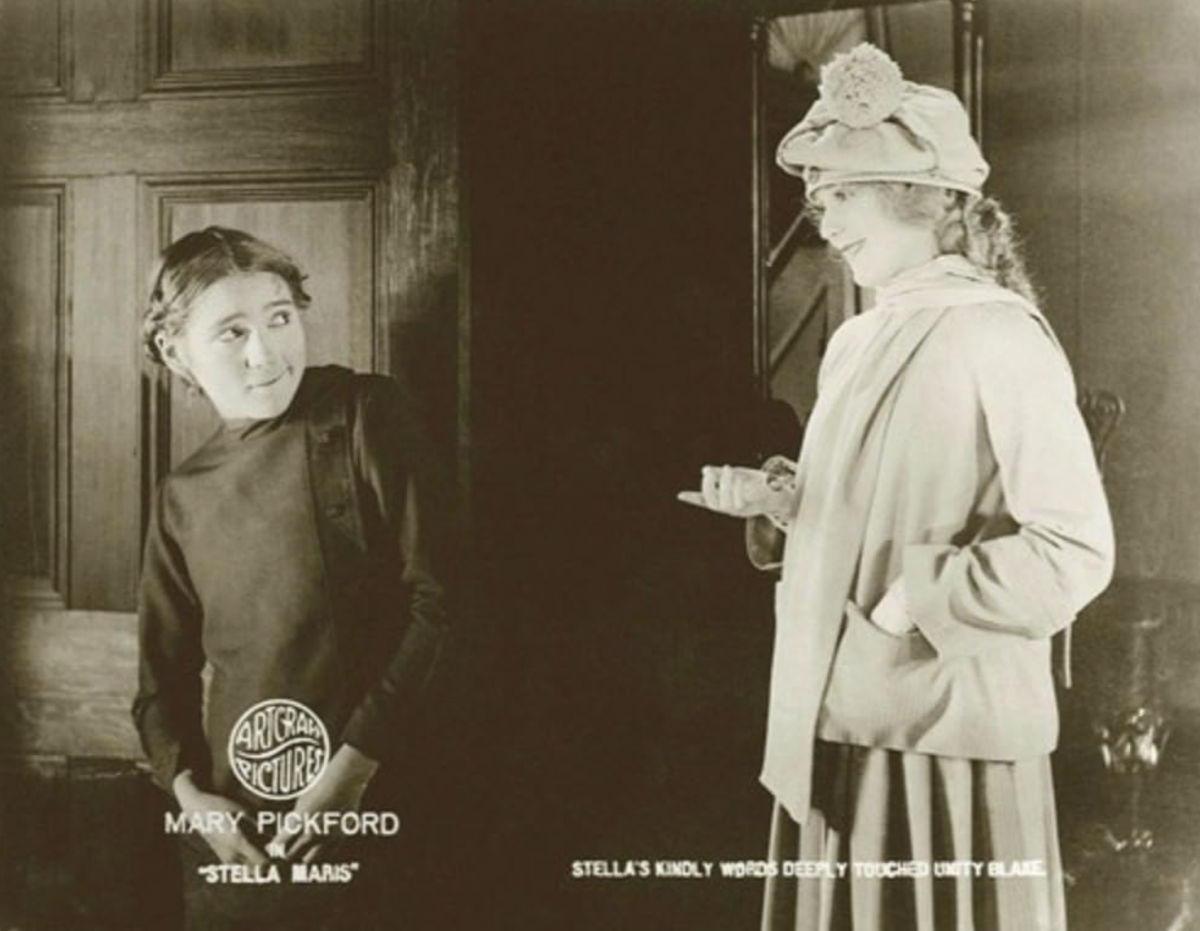 medical science finds a cure for Stella Maris’ paralysis and, after an operation, she regains the use of her legs. But while her new ability to walk is a great blessing, it comes at a price. Now she comes into contact with the outside world and learns, for the first time, that pain, sadness, and injustice exist in life—a sobering disillusionment. Mary Pickford received well-deserved critical praise for her performance in this challenging dual role. Her supporting cast, too, is excellent, notably Conway Tearle as the writer who loves Stella Maris and eventually adopts Unity; and Marcia Manon, who gives a hair-raising performance as Tearle’s abusive, alcoholic estranged wife.
Behind the camera, too, Stella Maris benefits from a surplus of talent. The scenario is the work of the celebrated Frances Marion, who had already achieved a position of power in Hollywood and was a frequent collaborator on Pickford’s films. The vogue for dual-role performances had created an arena for studio cameramen to show off their skills, and Walter Stradling, a key member of Marshall Neilan’s team, acquits himself well here. Not only does he picture the two Mary Pickfords together on screen with practiced skill (even setting himself some additional technical challenges along the way), he also graces the picture with the lovely exteriors, and composition and lighting effects, that were becoming his signature. As for Neilan himself, this film is emblematic of his extraordinary range. We may remember him for his charming comedies, and they are, indeed, a delightful legacy in themselves. But he was also a director of rare sensitivity, when he chose to exercise it; given a story with more dark or serious overtones, he never shied away from them. Stella Maris offers ample evidence: a film of charm, thoughtful reflection, aching melancholy—and, in the end, a fragile, delicate beauty.
