

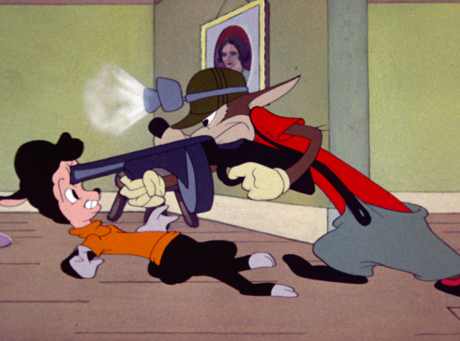
Famous/Paramount, 1946. Director: Izzy Sparber. Story: Joe Stultz. Animation: Dave Tendlar, John Gentilella. Music: Winston Sharples.
The Golden Age of American animation—which I would identify as, roughly, the 1920s through the 1940s—produced such a bountiful harvest of classic animated films that it’s difficult to take it all in. So dazzling is the combined output of the Disney, Fleischer, Warner, and MGM studios that the proliferation of lower-profile animation studios may easily be overlooked. If we seek out their films, however, and view them on their own terms (the recurring theme of this column), we find a trove of hidden gems. Such an overlooked producer is Famous Studios, which came into being in the early 1940s. The Famous cartoons, famous or not, have been routinely overshadowed for decades. But now a new Blu-Ray from Cartoon Logic has brought the best of them into the spotlight in an elegantly restored and produced showcase.
Animation enthusiasts know that the Fleischer studio, during its heyday, distributed its cartoons through Paramount Pictures. In 1942, however, Paramount seized control of the studio, ousted the Fleischer brothers, and rechristened the operation Famous Studios. (The “Famous” appellation was a common Paramount branding practice at the time—a tradition dating back to 1912, when Adolf Zukor founded his Famous Players studio, one of the foundational pillars of the Paramount empire.) The reconstituted studio retained much of the Fleischer talent and continued some of the Fleischers’ cartoon properties, notably Popeye the Sailor. But they also inaugurated a new series, Noveltoons, which branched out in experimental directions and introduced new characters. Among the latter, I’m especially intrigued by a subseries featuring Blackie Sheep and his predator/rival/foil, a perpetually hungry wolf voiced by Sid Raymond.
A diminutive lamb menaced by a big, hungry wolf—but Blackie is no meek little victim. On the contrary, he’s a street-smart wise guy, a character fully in keeping with the brash wartime spirit of the 1940s. He also has a distinct personality of his own: he’s not a frantic maniac like Daffy Duck or Woody Woodpecker, nor yet an ultra-cool hipster like Bugs Bunny. Generally speaking, Blackie minds his own business until the wolf turns up with a new scheme against him, whereupon he demolishes the predator with effortless ease and a jeering wisecrack. The wolf, for his part, is so hilariously stupid that it’s a joy to watch Blackie turn his own devices back on him. These cartoons draw heavily on gags and conventions that were common to most animation studios at the time, but deploy them in a distinct original style.
One of the Blackie entries featured on the new disc, Sheep Shape, finds the wolf driven not by hunger but by greed. Learning that Blackie has accumulated a huge sum of money for charity, the wolf temporarily gains possession of the cash. 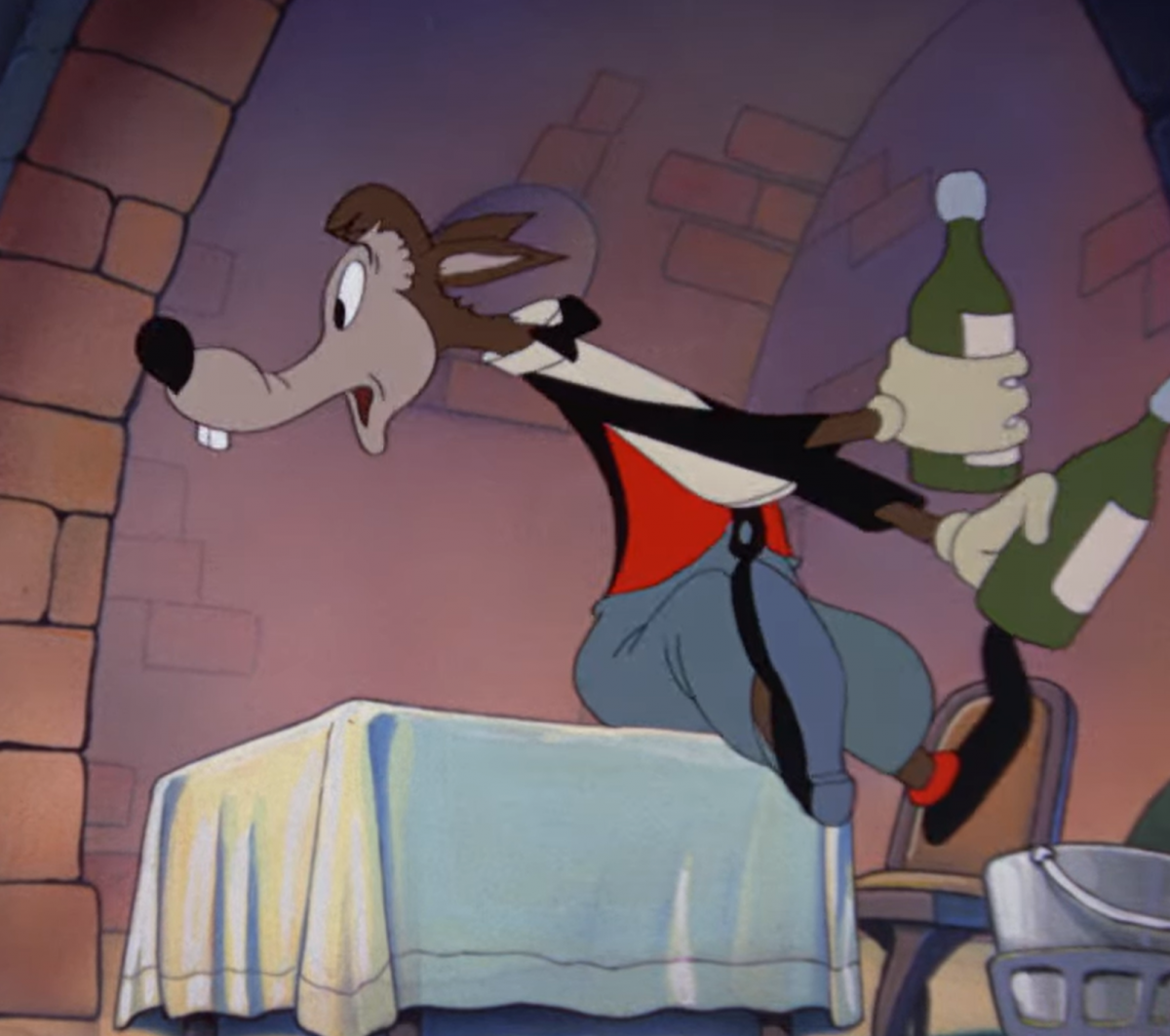 We next see him squandering his new wealth at a nightclub, driven into a frenzy of excitement by the sultry singer onstage. To even the most casual cartoon fan, this scene will instantly suggest the Tex Avery classic Red Hot Riding Hood, released by MGM just three years earlier. But look again: this scene is not simply a replay of the Avery classic. The singer onstage is not a flashy showgirl but a petite, delicate performer who croons seductively. Moreover, as she concludes her number, we finally see that “she” is Blackie himself in disguise, setting the stage for a satisfying slapstick finale which I will not describe here.
The Fleischers, while they lasted, had benefited from their access to Paramount’s resources, including the use of songs copyrighted by Paramount’s music-publishing houses. The Famous studio, of course, enjoyed the same privileges. When the spurious songstress in Sheep Shape begins “her” number, it’s a bona fide hit song: “I’m in the Mood for Love,” by the top songwriting team of Dorothy Fields and Jimmy McHugh. The song had been introduced in 1935 in the Paramount musical Every Night at Eight, and had been reprised in other films in the meantime. By 1946 it was established as a standard.
The Famous studio fulfilled its promise for a number of years, but then began to slip into lackluster routine. In the 1950s, Paramount sold the studio to the Harvey company, and some of its original characters—Casper the Friendly Ghost, Herman and Katnip, Baby Huey—became staples of TV cartoons. But during that brief interim in the 1940s, the studio distinguished itself with a solid body of work: expertly crafted color cartoons that did not simply ape Fleischer’s (or anyone else’s) past glories, but asserted an artistic identity of their own. We owe our thanks to Cartoon Logic, and to another boutique label, Thunderbean Animation, for rescuing these works from obscurity, restored to their original visual charm.
