

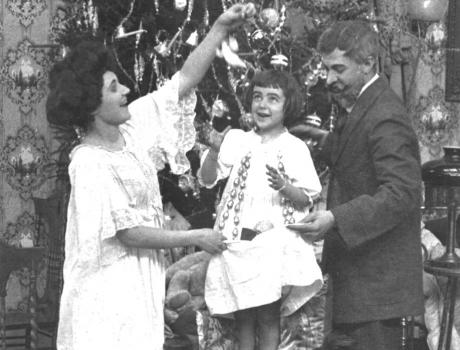
Biograph, 1908. Director: D.W. Griffith. Camera: Arthur Marvin. Cast: Harry Solter, Florence Lawrence, Marion Leonard, George Gebhardt, Linda Arvidson.
In December I like to feature a Christmas movie in this space—an offbeat one, if possible—and this month we have one that certainly lives up to that description. An Awful Moment has a Christmastime setting, and it ends with a pleasantly heartwarming family scene, but it arrives at that conclusion only after an episode of melodramatic suspense. Directed by D.W. Griffith, it was produced in November 1908, about five months into Griffith’s legendary directorial tenure at the Biograph company. As such, it’s one of a select group of films that mark a pivotal moment in history.
Regular readers of this column know that I’ve commented, more than once, on The Biograph Project, the heroic effort by our friends at Film Preservation Society (FPS) to restore and preserve every one of Griffith’s Biograph films. I make no apology for those multiple tributes, nor for this one; to anyone who cares for classic film, there can be no more worthwhile undertaking than restoring these essential films to their original visual brilliance. FPS is continuing its painstaking work on the Biographs in more or less chronological order, and at this writing has restored most of the titles from 1908. Tracey Goessel, the Society’s president, attended this year’s Giornate del Cinema Muto in Pordenone, and exhibited a selection of the group’s latest restorations. As usual, these programs were some of the most outstanding highlights of the festival (in a week that offered plenty of highlights).
The selection concluded, appropriately enough, with An Awful Moment, which had originally been released to theaters just before Christmas 1908. It’s doubly appropriate to feature it here—for, in this gift-giving season, An Awful Moment represents a doubly precious gift from FPS to the film community. Not only can we see it with the sharpness and clarity that its first audiences saw in 1908—the exciting advance made possible by all of these restorations—we can also see it in its proper continuity! Most of the FPS restorations are based on the paper prints that Biograph produced in those pre-1912 years for copyright purposes, but some of those paper prints come with special problems of their own. This one was printed before the film had been edited for exhibition. It contained all the shots Griffith and his cameraman had filmed, but in wildly jumbled order. Now, after more than a century, FPS has restored the shots to their proper continuity order, and we can enjoy Griffith’s cinematic storytelling as he intended it to be seen.
And An Awful Moment, like so many of the Biographs, is all about the storytelling. One of the first cinematic principles Griffith had discovered was the power of editing, and in particular crosscutting. If one character was in danger and another was approaching with a threat, or rushing to effect a rescue, the filmmaker could work the audience into a state of nearly unbearable suspense by cutting repeatedly between all the parties concerned. By the autumn of 1908 Griffith was experimenting with this device, and a fair share of the Biographs climaxed with some kind of suspenseful situation.
Here, the situation is motivated by revenge. The film opens in a courtroom where a gypsy, convicted of some unspecified crime, is being sentenced by the judge. The gypsy’s wife flies into a rage and stages a vehement scene in the courtroom. The wife is played by Marion Leonard, who had joined the Biograph stock company only a few months earlier and was rapidly establishing herself as a major screen presence, well suited to volatile roles like this one. Ejected from the courtroom, she lies in wait and follows the judge home at the end of the day (affording us one of those fascinating New York street exteriors, made possible by the Biograph studio’s location in lower Manhattan).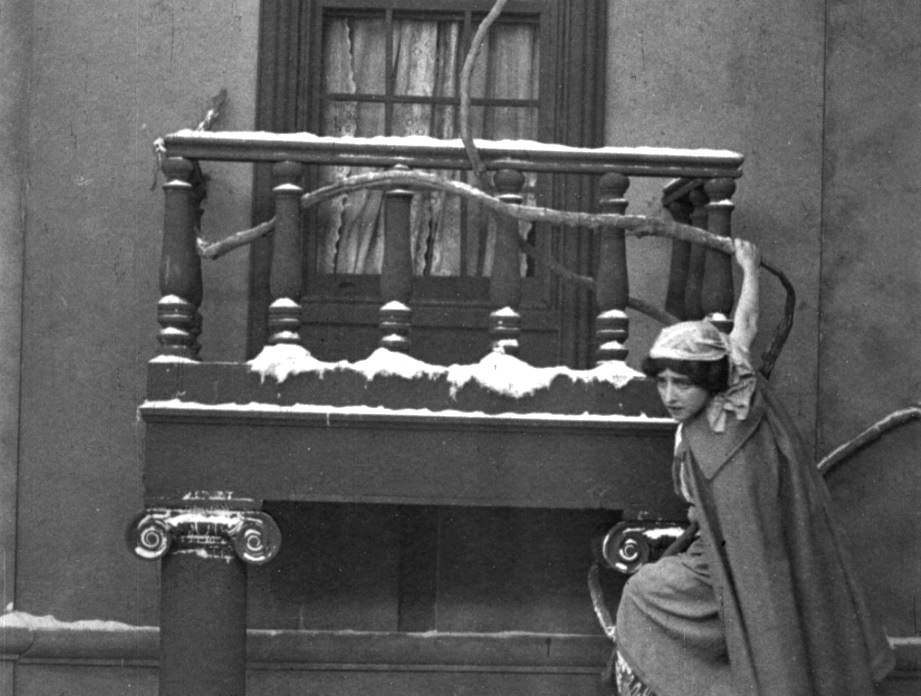 Having ascertained his address, she scales the outside of the building (!), breaks in through a window, hides in the house, and concocts an elaborate trap that will cause the judge inadvertently to fire a gunshot that kills his own wife.
But it’s Christmas Eve, and now we see another side of the judge’s (Harry Solter) persona: not only a stern enforcer of the law, but also a loving family man with a wife and daughter. His wife is played by Florence Lawrence, another early luminary in Griffith’s company, as sweet and affectionate as Marion Leonard is explosive and vengeful. (We should add, however, that Lawrence was an actress of considerable range in her own right. Another of the FPS offerings in Pordenone this year was Griffith’s adaptation of The Taming of the Shrew, in which Lawrence was a formidably hot-tempered Katherine.) The ensuing suspense hinges on whether Leonard’s sadistic device will be discovered in time, or whether it will succeed in its deadly objective.
That suspenseful episode is, of course, the raison d’être of this bracing little melodrama. And now, thanks to the efforts of the Film Preservation Society, lucky viewers can experience it as its first audiences did. FPS has already generously shared samples of its restored Biographs as bonus features on its Blu-Ray releases (which, of course, are already of enormous value in their own right). Now, as the judge and his family enjoy a warm holiday vignette at the end of this film, we can renew our thanks for those previous gifts, even as we look forward to this and others in the future.
